Breitling Navitimer B09 & B02 Chronograph 41: Hand-Wound Navitimers Join the Core Collection
For most of the past decade, if you wanted a hand-wound Navitimer you had to catch a limited edition in the window when it appeared — and hope Breitling kept the calibre in play afterwards. That changed quietly in the week of October 19–23, 2026. As Crown & Caliber reported in "Everything You Need to Know This Week in Watches (October 19–23)" (October 23, 2026), Breitling has added two manually wound, 41mm steel Navitimers to its permanent, non-limited core collection: the Navitimer B09 Chronograph 41 and the Navitimer B02 Chronograph 41 Cosmonaute. Both carry the circa-1960s Twin Jet logo on the dial, a deliberate nod to the reference era that made the Navitimer a pilot's instrument rather than a pilot's accessory.
Why a hand-wound Navitimer matters
The Navitimer is one of the great aviation watches: introduced in 1952 with its circular slide-rule bezel, it let pilots compute fuel burn, climb rates and ground speed on the wrist, and it has carried that instrument logic — and that bezel — ever since. For much of its modern life, though, the collection has been powered by automatic movements. Hand-wound calibres have appeared in special releases, prized by people who like the daily ritual of winding and the slimmer, more traditional feel of a manually wound chronograph on the wrist. Moving two hand-wound references out of the limited-edition lane and into the core catalogue is a small change on paper and a significant one in practice: it tells you Breitling expects lasting demand, not a collector's novelty spike. It also gives buyers a stable reference to shop against, which matters whether you are buying new or exploring Pre-Loved (Certified) watches.
The B09 Chronograph 41, explained
The Navitimer B09 Chronograph 41 pairs the classic case with the in-house manual-wind B09 movement — a calibre that, until now, Breitling had reserved for limited editions. It is offered with a black or a blue dial, and per Crown & Caliber it is priced at $7,900 on leather or $8,400 on bracelet. In practical terms, the B09 is the purist's Navitimer of this announcement: the familiar pilot's dial layout and slide-rule bezel, a hand-wound chronograph calibre developed in-house, and a 41mm steel case that wears comfortably on a range of wrists. If you have always wanted the winding ritual and the vintage-leaning character without chasing a numbered edition, this is now the standing option. Our primer on what makes a chronograph a chronograph covers the pushers, registers and timing functions both of these references share.
The B02 Cosmonaute and its 24-hour dial
The second reference is more specialized. The Navitimer B02 Chronograph 41 Cosmonaute runs the COSC-certified in-house B02 movement, a hand-wound calibre with a 24-hour time display — the single dial that reads noon and midnight as genuinely different times. That convention is the Cosmonaute's signature, and it traces back to the model's association with astronaut Scott Carpenter's 1962 Aurora 7 Mercury flight, for which a 24-hour Navitimer was conceived so a day in orbit could be read unambiguously. Breitling has otherwise reserved the B02 for Cosmonaute models, and this release keeps the calibre where it belongs — inside the Cosmonaute — while removing the limited-edition gate. Pricing, per Crown & Caliber: $10,600 on brown leather or $11,000 on bracelet.
How to choose between them
Both are hand-wound, 41mm steel chronographs with the Twin Jet dial logo, so the decision comes down to the dial and the calibre. The B09 is the everyday choice: conventional 12-hour time, black or blue dial, and the lower price of the pair. The B02 Cosmonaute is the connoisseur's pick — a COSC-certified hand-wound movement with the 24-hour display and a story that runs through the Mercury program. If you have never lived with a 24-hour dial, understand that reading it is a small habit, not a hardship: the hand passes each hour mark once per day, and noon sits opposite midnight on the scale. If that appeals, the Cosmonaute is one of the most distinctive dial formats in modern watchmaking. If not, the B09 delivers the hand-wound Navitimer experience with none of the adjustment. Collectors who appreciate this kind of design-led storytelling may also enjoy our piece on Breitling's Navitimer Miles Davis tribute.
Collecting and wearing notes
Hand-wound chronographs reward attention. Wind yours at roughly the same time each day, stop when you feel resistance — never force the crown — and avoid winding while the chronograph is running, which some calibres discourage. The 41mm steel case is versatile with suits and denim alike, and the leather-versus-bracelet choice is genuinely a choice here: the bracelet adds $500 on both references and changes the watch's character from vintage-leaning instrument to full steel tool. On the secondary market, note that these two references enter the core collection with the Twin Jet logo — a detail historically tied to the 1960s references that collectors actively seek, and now part of the modern specification.
Buying a Pre-Loved (Certified) Breitling at LuxyVerse
News like this tends to lift interest across an entire family of references, and the Navitimer's history runs deep: slide-rule bezels, 24-hour dials, and decades of pilot's watches in between. You can browse the Breitling collection at LuxyVerse to see current availability, with every piece authenticated and described in full — New and Pre-Loved (Certified). Because these two calibres spent years available only in limited editions, earlier hand-wound Navitimers occupy interesting territory for collectors: the same manual-wind character these new references now make permanent, often at a very different price point. As always with Pre-Loved (Certified) pieces — and we say this deliberately — a Pre-Loved (Certified) piece from a specialist you trust beats an unknown listing from a stranger, because condition, service history and authenticity are the entire value proposition.
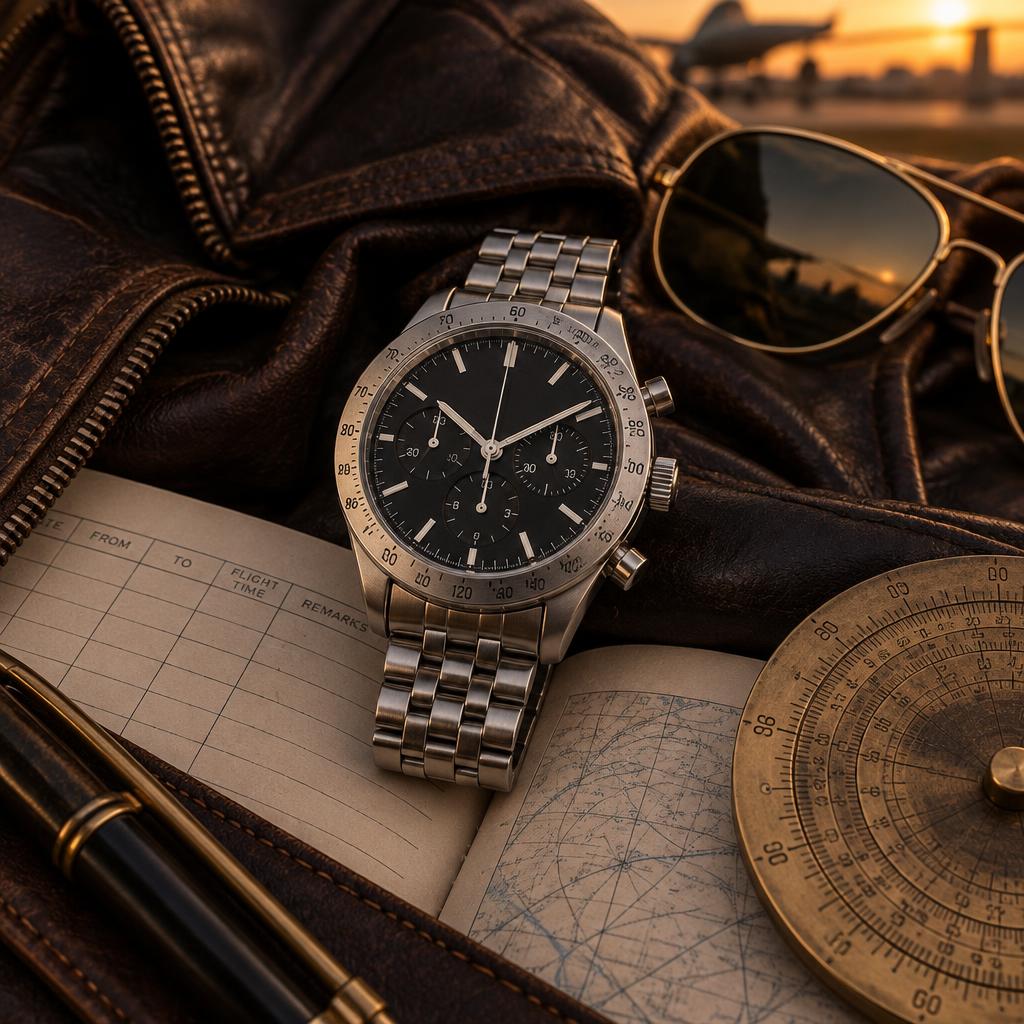
Featured image: an original AI-generated study of a pilot's chronograph with an aviation flight log and flight computer, created for The Verse. It depicts no specific brand or model.