Cartier Baignoire 2026: Five New Models of the Oval Jewelry Watch
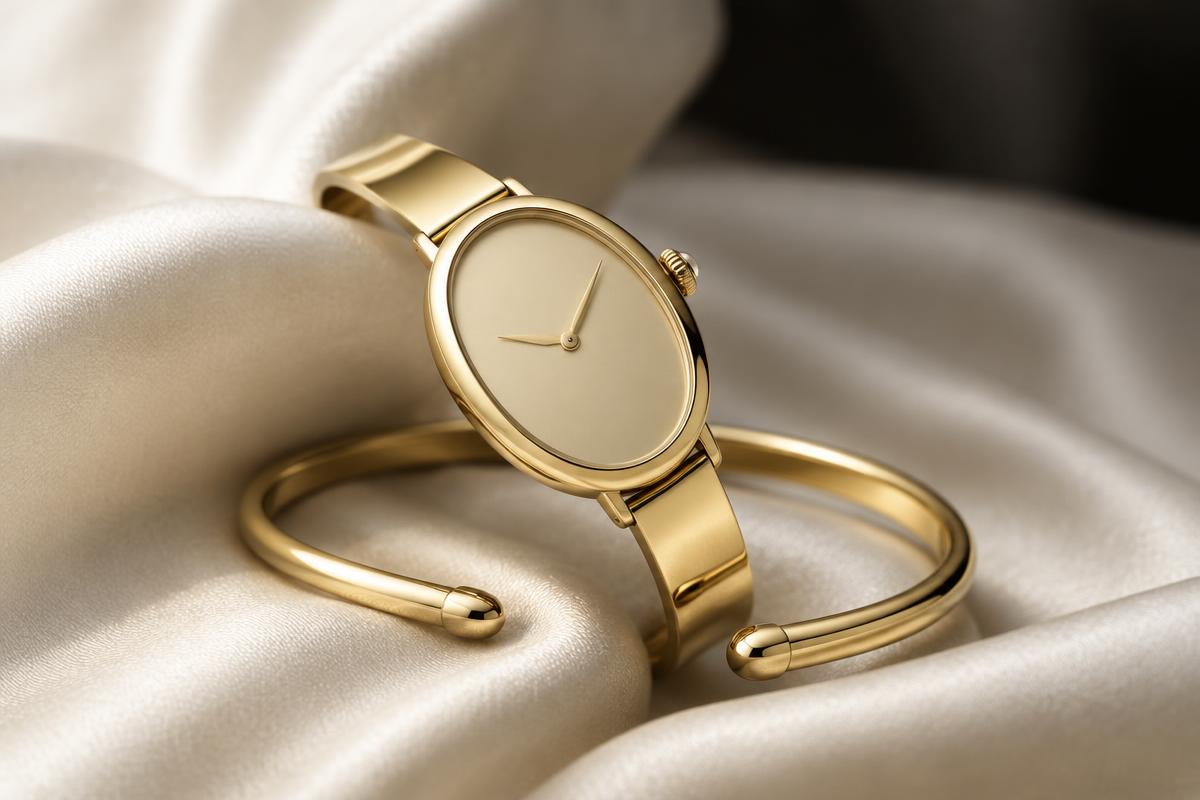
A category of watch belongs as much to the jewelry box as to the watch box: small, oval, precious metal close to the skin, unbothered by complications. Cartier's Baignoire is its purest expression, and 2026 is an unusually generous year for it. According to webChronos / Chronos Japan (13 November 2026), Cartier has unveiled five new Baignoire models at WWG2026 — two bangle watches and three strap models, with diamond-set or black lacquer dials plus a silver dial. All five are cased in 18K yellow gold and water resistant for everyday use.
For a collector who moves between watches and fine jewelry with equal seriousness, this release is worth pausing on: it states plainly what a watch can be when the jeweler, not the engineer, sets the brief.
From 1958 to a name
The Baignoire line is compact in its history, and that is part of its coherence. The watch traces to an oval watch created in 1958; it received the name Baignoire in 1973. The bangle versions, in which the case is fused to an open cuff instead of fitted with a strap, arrived in recent years.
That chronology explains the design's restraint: the form was settled early, so the house has spent decades refining proportion, metal and setting rather than chasing novelty. In a market where many releases are recolors of an existing case, five references at once across two constructions is a different order of news.
The five new models
Two of the five are bangle watches, worn as a cuff with the case as its centerpiece.
Ref. CRWGBA0070 — 18K yellow gold bangle carrying a Clous de Paris motif across case, bracelet and dial, with a cabochon sapphire crown. Quartz; 24.6 x 19.3 mm, 7.5 mm thick.
Ref. CRWJBA0068 — 18K yellow gold bangle set with 49 brilliant-cut diamonds on the case, 122 on the bracelet and 100 on the dial, the crown diamond-set as well. Quartz; 24.6 x 19.3 mm, 7.5 mm thick.
The remaining three are strap models, each with a different dial personality.
Ref. CRWGBA0074 — 18K yellow gold case, dial set with 100 brilliant-cut diamonds, on a black patent calfskin strap. Quartz; 24.6 x 18.7 mm, 7.2 mm thick.
Ref. CRWGBA0068 — 18K yellow gold case with a glossy black lacquer dial, gold Roman numerals and sword hands. Quartz; 31.4 x 23.1 mm, 7.3 mm thick.
Ref. CRWGBA0059 — 18K yellow gold case with a silver-finished dial, Roman numerals and blued steel sword hands. 36 x 26 mm, 8.6 mm thick.
Read together, the five run from the quietest expression — a lacquered dial and gold numerals — to a piece whose dial is itself a pavé setting. The Clous de Paris model sits between them, and makes the strongest argument of the group: that texture alone, without a single stone, can carry a jewelry watch.
Japan retail prices
webChronos lists Japanese retail prices including tax: ¥3,841,200 for CRWGBA0070; ¥10,824,000 for CRWJBA0068; ¥2,362,800 for CRWGBA0074; and ¥2,851,200 for CRWGBA0059. No price was published for CRWGBA0068 in that report, and we have not converted the figures into other currencies.
Why the oval jewelry watch matters
The oval is the most demanding shape in watchmaking and the least obvious. A round case hides its movement behind a symmetrical dial; an oval case puts its proportions on display, where a millimetre of excess reads at once. It also sits differently on the wrist — the long axis follows the bone, so the watch looks integrated rather than perched on top.
Cartier's authority here comes from its first trade: the house built its reputation as a jeweler, and the Baignoire is that inheritance made wearable, sharing a design language with bracelets, rings and earrings rather than with tool watches. For how that language developed, our own look at the history of Cartier's iconic bracelets is the best companion piece to this release.
Choosing a Baignoire for the wrist
Because the oval reads along the wrist, size is a question of proportion rather than diameter. The two bangle watches and CRWGBA0074 are small and jewel-like; CRWGBA0068 and CRWGBA0059 step up into a more present, watch-like presence. On a slender wrist the smaller cases sit flush and read as jewelry; on a broader wrist the bigger references hold their own. The honest test is distance: look at the piece from across the room, where the shape either balances with your wrist or it does not.
Bangle or strap
A bangle watch is a commitment. Worn as a cuff, it becomes the loudest thing on the arm and rarely layers well with other bracelets; it also has to fit precisely, since a rigid cuff cannot be adjusted the way a strap can. In exchange it delivers something a strap cannot — case and bracelet as one continuous object, which is the whole point of the design.
A strap model is more forgiving and more often worn: adjustable through the day, slipped under a cuff, rotated with other pieces. Patent leather, as on CRWGBA0074, is gorgeous but delicate, and dislikes moisture and friction. If this is your first Baignoire, or the one you will reach for daily, a strap reference is the more wearable choice; if you already own the daily watch and want the object, the bangle is the reason the line exists.
Living with 18K gold and pavé
Yellow gold of this purity is soft enough to take fine scratches, and a bangle worn daily will accumulate them; that is normal wear, not a defect. Keep the piece separate in a soft pouch rather than a shared box, wipe it with a lint-free cloth after wear, and have any pavé-set piece checked periodically so a loose stone is found before it is lost. Perfume and lotion go on before the watch, not after. Cleaning a diamond-set dial or a lacquered surface is a service job, not a home job.
On the Pre-Loved (Certified) market
The same qualities that make a new Baignoire appealing give the secondary market its depth. Cartier's design continuity means a piece made decades ago remains unmistakably itself, so a Pre-Loved (Certified) example offers a look that cannot be bought new. It also means buyers should weigh the jewelry-watch details, not only the movement: case condition, the integrity of any pavé, the originality of the dial and crown, and the documentation. Because these are small precious-metal objects worn close to the skin, condition and provenance separate one piece from another more decisively than on a steel sports watch.
If you collect on both sides of the jewelry box, begin with the pieces our specialists have authenticated and inspected: the Pre-Loved (Certified) Cartier collection, the women's watches page for the wider field, and the bracelets category for the pieces a bangle watch was always meant to sit beside.
Five references, one idea: that a watch need not be a machine to be worth collecting. The Baignoire has made that argument since 1958, and in 2026 Cartier has made it louder than it has been in years.
Sources: webChronos / Chronos Japan, 13 November 2026; Cartier. The featured image is brand-neutral and AI-generated; it depicts no specific reference.