IWC Turns the Portugieser Purple: The Kurt Klaus Calendar at Its Most Lavish
Some watches announce themselves by complication. This one announces itself by colour. IWC has given the Portugieser — a line that has resisted novelty for nearly nine decades — its first purple dial, and mounted on it nothing less than the house's perpetual calendar and a flying minute tourbillon. According to Esquire Australia, in "Everything happening in the world of watches this October" (October 2026), the new Portugieser Perpetual Calendar Tourbillon, Ref. IW504509, is limited to 50 pieces in a 45mm platinum case standing 15.3mm high. No price has been published.
It is a striking move for a watch whose origin story is famously practical: nearly ninety years ago, two Portuguese merchants commissioned a wristwatch with the precision of a marine chronometer. The answer was a large, clean dial with applied Arabic numerals and a thin bezel — legibility as luxury. A purple dial is the opposite impulse, and that contrast is precisely what makes the release worth a collector's attention.
A dial that earns its drama
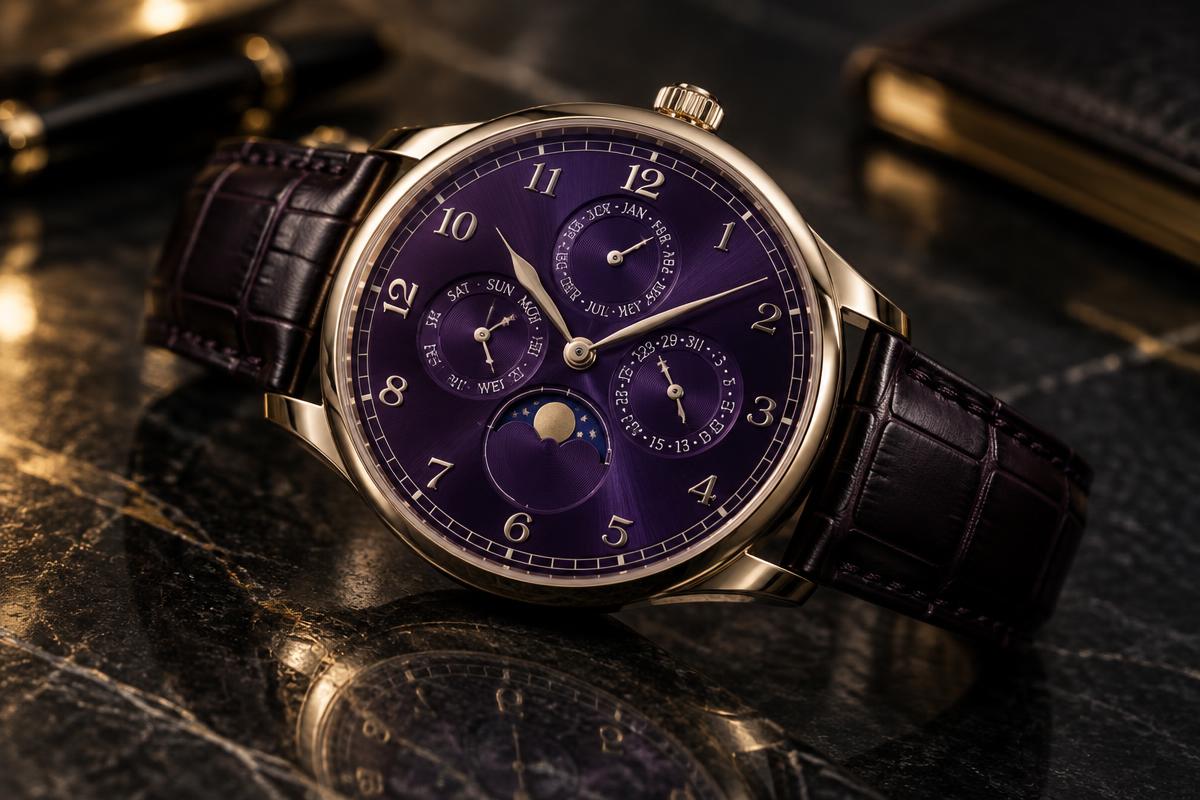
The sunray-finished purple dial is laid out in the Portugieser's classic grammar: hand-set rhodium-plated Arabic numerals, a railway-track minute scale and leaf-shaped hands. The strap, fittingly for a dial this saturated, is a hand-coloured black alligator piece by Santoni closed with a platinum folding clasp. Nothing about the specification is timid, yet every element is one the Portugieser has worn before — the colour is the only genuine first, and IWC has clearly decided that a first of this size deserved the house's most serious mechanics beneath it.
At 45mm, this is a watch that will dominate a wrist — and a long line of discussion about what the Portugieser should be. It is worth remembering that the reference has always swung between restraint and grandeur; our luxury watch size guide is a useful companion for anyone weighing a case this presence-forward.
The engine: calibre 51950
Inside sits the in-house calibre 51950, a movement of 447 parts wound by IWC's signature Pellaton system, which converts the rotor's motion into winding through a pawl-and-wheel arrangement beloved by connoisseurs for its mechanical charm. The movement delivers seven days of power reserve from a single barrel, and the Breguet-overcoil balance beats at 19,800 vph — a traditionally leisurely cadence that favours stability over spectacle. Through the sapphire caseback you will find Geneva stripes and a solid 18-carat gold rotor, the sort of finishing that signals where a manufacture believes its money pieces sit.
Kurt Klaus's quiet masterpiece
The perpetual calendar itself is the deeper story. It was developed by Kurt Klaus in the 1980s, and its genius lies in reduction: the entire mechanism — date at 3 o'clock, day at 9, month and moon phase at 6, and a four-digit year — is set entirely through the crown. Where other perpetuals demand pushers, styluses and a printed instruction card, Klaus's design asks for nothing but a few turns of the crown. It is one of the most elegant solutions in watchmaking, and it has carried IWC's calendar watches for four decades.
The moon phase deserves its own sentence: it deviates by one day every 577.5 years. A collector who wears such a watch daily and never adjusts the moon will be off by a single day in the late 26th century. That is the kind of quiet over-engineering that makes a perpetual calendar worth keeping, servicing and passing on rather than trading.
The tourbillon finds its place
At 12 o'clock sits the flying minute tourbillon — 82 parts weighing 0.635 grams — a construction whose entire carriage pivots on a single axis with no upper bridge to obscure the view. The combination is not entirely new to the line: the flying minute tourbillon was first paired with this perpetual calendar on a Portugieser dial in 2018, for IWC's 150th anniversary. What the new reference adds is the colour, the platinum and the sense of a house treating its calendar architecture as a flagship platform rather than a historical footnote.
What this means for collectors
A maison that puts a brand-new colour on a legacy complication is making a statement of confidence: the underlying mechanism needs no further proof, so the case and dial are free to experiment. For collectors, the practical reading is that perpetual calendars remain among the most satisfying complications to own over the long term. A few habits keep them that way. Buy the complete set — box, papers and a documented service history — because a calendar movement's value rests on knowing it has been cared for. Learn the setting sequence before you wear it, and resist the urge to correct a date by improvised means; the crown-driven design makes proper adjustment easy precisely so that shortcuts are unnecessary. And when the watch is worn regularly and serviced on schedule, the complication becomes part of daily life rather than a museum piece.
That is also where the Pre-Loved (Certified) market earns its keep. A perpetual calendar is exactly the category of watch where provenance matters most: a piece that arrives inspected, authenticated and documented — with its movement checked by people who understand a 447-part calendar — can be bought with the same confidence as a new one, often from a reference that is no longer produced. Start from our watches collection, look for the houses whose calendar architecture has stood the test of time on IWC and beyond, and read our Authenticity Promise before you commit.
The purple Portugieser will find its fifty owners, and they will be lucky ones. But the more durable story sits beneath the dial: Kurt Klaus's calendar, still setting the standard for how simply a watch can count the years. Featured image: an original AI-generated, brand-neutral depiction of a purple-dial perpetual calendar watch; it does not depict the actual Ref. IW504509.