Jaeger-LeCoultre Calibre 101 Chain: The World's Smallest Movement Becomes High Jewellery
For much of the past two decades, the conversation in fine watchmaking has belonged to steel sports watches and complications measured in patents. Quietly, the jewellery watch has been reclaiming its place — the piece worn first as an ornament and second as an instrument, yet built with the same mechanical seriousness. Few houses can make that argument with more authority than Jaeger-LeCoultre, and on October 13, 2026 it made it emphatically, unveiling the Calibre 101 Chain, reference Q2842270, in Hong Kong.
The setting was itself a statement. According to Jaeger-LeCoultre's press release, the watch debuted at the first-ever exhibition of the maison's The Collectibles programme, held at The Chater House in Central, Hong Kong, from October 13 to 19, 2026. The exhibition marked the programme's seventh capsule — ten museum-grade vintage pieces, which Jaeger-LeCoultre also offers through jaeger-lecoultre.com. Placing a new high-jewellery creation among restored historical watches was a deliberate way of saying that the Calibre 101 Chain belongs to a lineage, not a trend.
The 1955 Chain and the Duoplan heritage
That lineage is explicit. Jaeger-LeCoultre says the new piece is inspired by a 1955 Duoplan model nicknamed the "Chain" for its braided gold-link bracelet, and that original was shown in the Hong Kong exhibition alongside its descendant. The Duoplan name refers to the two-level movement architecture the manufacture patented in 1925 — a way of stacking components to make a mechanical watch dramatically smaller without sacrificing reliability.
The exhibition offered a second reminder of how deep this history runs: a circa-1950 Art Deco Calibre 101 in platinum 950, its case just 6.15 mm wide and set with 22 baguette diamonds in total. Seen together, the vintage pieces and the new Chain describe one idea carried across seventy years — that a watch small enough to disappear into a jewel can still be a genuine mechanical object.
The making of the bangle
What distinguishes the Calibre 101 Chain is the order in which it was conceived. Jaeger-LeCoultre states that the bracelet was designed first, with the case and movement integrated afterward. This is a jewel that happens to tell time, rather than a watch dressed in stones.
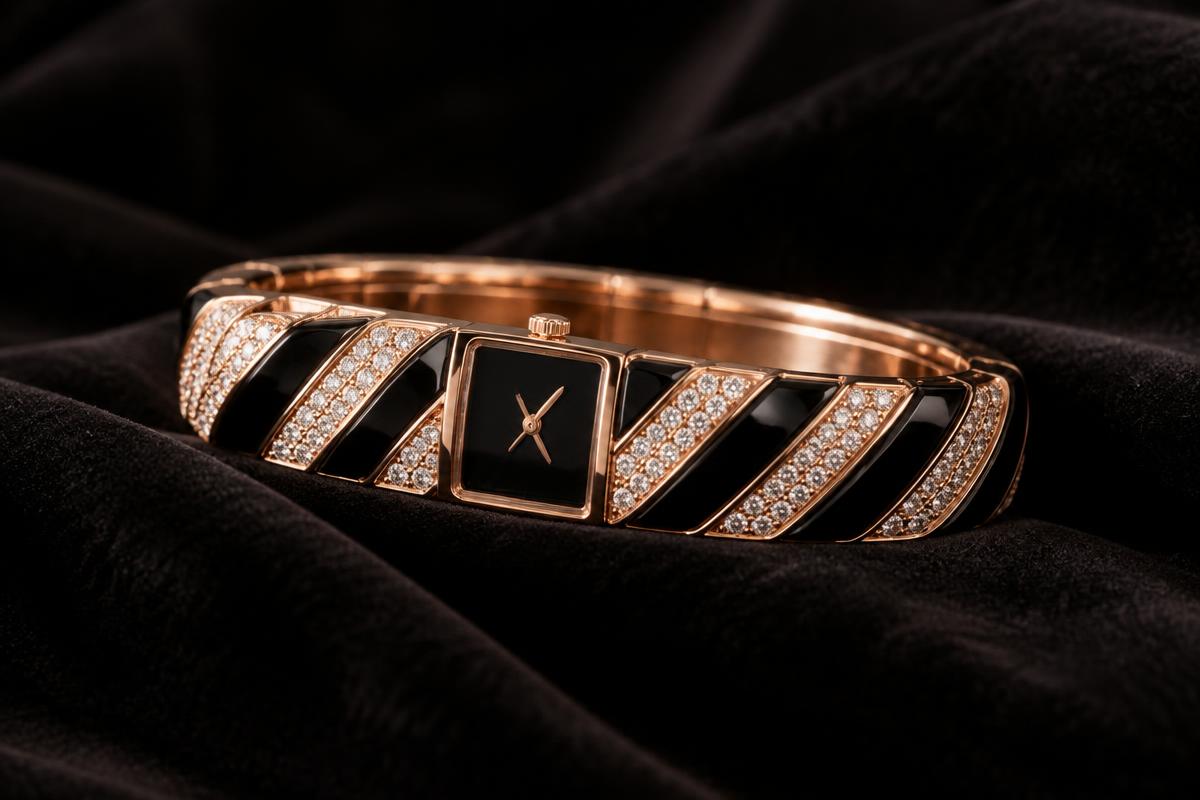
The bangle is sculpted in 18K pink gold, with diagonal bands alternating brilliant-cut diamonds and glossy black Hyceram, a ceramic-polymer composite. The process the maison describes is painstaking. Each bangle is cast in its own mould; 36 cavities are then filled by hand with liquid Hyceram, cured and polished flush with the gold. Only then does a master gem-setter set the diamond bands. In total, Jaeger-LeCoultre cites 158 brilliant-cut diamonds of approximately 2.73 carats.
The watch itself is almost a whisper within the design: a black lacquered dial bearing the JL monogram, slim stick hands, and a diamond-set bezel. The case measures 18.60 x 5.98 mm and is 6.75 mm thick. The contrast of black Hyceram, pink gold and white diamonds gives the piece a graphic, almost Art Deco rhythm — a clear nod to the era in which the movement inside was born.
Calibre 101: a century of miniaturisation
The heart of the watch is a legend. Introduced in 1929 using the Duoplan architecture, Calibre 101 is, as Jaeger-LeCoultre describes it, the world's smallest rectangular manual-winding mechanical movement. It measures about 14 x 4.8 mm, is 3.4 mm thick and weighs about one gram — and its dimensions have remained essentially unchanged for nearly a century.
Within that tiny footprint sit 98 components and 19 jewels, beating at 21,600 vibrations per hour (3 Hz), with a 33-hour power reserve and a display of hours and minutes. Hodinkee reports that each movement takes around 40 hours to assemble by hand. Those figures explain both the rarity and the reverence: the Calibre 101 Chain is not a limited edition, but Jaeger-LeCoultre and Hodinkee both note that only a few dozen are made each year. The price is on request.
How to think about collecting jewellery watches
The Calibre 101 Chain arrives at a moment when collectors are looking again at the jewellery watch as a category of its own — bangle watches, secret watches with concealed dials, and gem-set pieces where the bracelet leads. A few principles help when building a collection in this space.
Judge the jewel and the watch separately. In a piece like this, the gem-setting, the finishing of the metal and the integrity of the bracelet matter as much as the movement. Examine how evenly stones are set and how cleanly materials meet, much as you would assess any of the fine bracelets in a jewellery collection.
Plan for servicing tiny movements. Miniature calibres demand specialist hands. A manual-winding movement this small rewards regular, gentle winding and service by watchmakers familiar with the calibre — ideally through the maison's own network.
Value provenance and documentation. Jewellery watches are frequently worn, gifted and inherited, so original boxes, papers and service records carry real weight. Jaeger-LeCoultre's own Collectibles programme, built on restored and documented vintage pieces, underlines how much provenance shapes desirability.
Consider Pre-Loved (Certified) pieces. New high-jewellery watches like the Calibre 101 Chain are produced in very small numbers and offered on request. For many collectors, the more accessible path into elegant, gem-set and dress women's watches is a Pre-Loved (Certified) piece that has been authenticated and inspected before sale, so the decision rests on condition and history rather than uncertainty. Jewellery-led watchmaking has a long tradition — the history of Cartier's iconic bracelets shows how a bracelet can become the defining object — and that tradition is well represented on the secondary market.
A jewel with a heartbeat
The Calibre 101 Chain distils what makes the jewellery watch compelling: an object designed to be beautiful first, yet animated by one of the most remarkable movements ever made. Its debut beside the 1955 Chain in Hong Kong framed it as a continuation of Jaeger-LeCoultre's history rather than a departure. For collectors, it is a reminder that the most intimate watches are often the most technically daring — and that the jewellery watch deserves a place in any considered collection.
Note: featured image is AI-generated and brand-neutral; it does not depict the Jaeger-LeCoultre Calibre 101 Chain.
Sources: Jaeger-LeCoultre official product page and press release (October 13, 2026); Hodinkee (October 14, 2026).