The Original MB&F Legacy Machine No. 1 Gets the EVO Treatment
Some watches define a manufacture so completely that everything afterwards is read through them. For MB&F, that watch is the Legacy Machine No. 1, the piece that introduced the brand's second collection in 2011 and turned a suspended balance wheel into an icon. Now, according to Hodinkee — writing on 13 October 2026, in an article by Mark Kauzlarich — the original Legacy Machine No. 1 has been given the EVO treatment. The house's most historic movement display has entered its most contemporary case.
What the EVO treatment means here
The EVO line is MB&F's sportier reading of its Legacy Machines, and as Hodinkee notes, it is now about six years old. The formula is consistent across the family: higher water resistance, the built-in FlexRing shock protection system, slightly less delicate dials, and a case designed with rubber straps in mind. Earlier EVO interpretations covered the Perpetual, the Sequential and Sequential Flyback, the Split Escapement and the LM101. The one machine that had not joined them was the original — until now.
Hodinkee reports two versions of the Legacy Machine No. 1 EVO, both available now. The first pairs Grade 5 titanium with a rhodium dial plate, priced at $109,000. The second is cased in 5N rose gold with a green dial plate, limited to 33 pieces, at $137,000.
The case itself carries the practical substance of the update. It measures 42 mm in diameter and 16.8 mm thick, with a 52 mm lug-to-lug span and an 18 mm lug width. Water resistance stands at 80 metres, and FlexRing shock protection is built into the construction. For a watch whose predecessor lived in the formal territory of dress-watch proportions, these are meaningful numbers: they describe a machine intended to leave the safe.
A case redesigned for quick-change straps
Two details are new even by EVO standards. The first is a quick-change rubber strap system, offered in grey or black, each fitted with a matching titanium or rose gold folding buckle. As Hodinkee explains, this was made possible by a redesign of the case — and it does not extend to other EVO models. The Legacy Machine No. 1 EVO therefore offers a small but real convenience its siblings lack: a change of strap that takes seconds rather than a trip to a bench.
The second is the power reserve indicator. On the original Legacy Machine No. 1, the indicator travelled vertically. Here it rotates side to side over an inclined scale, an arrangement Hodinkee finds more legible. It is a subtle revision, but a telling one: EVO has always been about making ambitious mechanics easier to live with, and readability is where that philosophy becomes daily experience.
The dial: a suspended balance, refined
The signature of every Legacy Machine survives intact. The floating balance hovers over the dual time display, suspended above the dial plate in a composition that once reset expectations for what a three-dimensional dial could be. In this execution, the dual time subdials are sunburst-polished black with a flat finish, and the indexes are printed Super-LumiNova. Legibility after dark was not a concern of the 2011 original; the EVO edition treats it as a requirement.
The movement and its pedigree
The movement beneath the suspended balance carries one of the most distinguished collaborative histories in modern independent watchmaking. It was developed in-house by MB&F with Jean-François Mojon, while the aesthetics and finishing were specified by Kari Voutilainen — a pairing that gave the first Legacy Machine its exacting hand-finished character. The calibre is manually wound and provides dual time zones with independent hours and minutes: the crown at 4 o'clock sets the right-hand display and winds the movement, while the crown at 8 o'clock sets the left-hand time zone. Specifications, as reported by Hodinkee, include a 60-hour power reserve, 18,000 vph and 25 jewels.
This EVO edition arrives with meaningful upgrades: a Straumann double hairspring, a redesigned and sleeker balance bridge, gold chatons with polished countersinks, and 19th-century-style hand finishing throughout. It is not chronometer certified — a point Hodinkee makes plainly, and one that reflects a philosophy of specification rather than an absence of care.
One practical consequence of the independent-crown architecture deserves attention. Because each time zone is set on its own, the watch handles 15- or 30-minute time-zone offsets — the geographies where a conventional GMT fails. Hodinkee observes that this makes it one of the more practical uses of the sporty EVO case, and it is difficult to argue otherwise. A traveller between, say, India and its neighbours needs half-hour adjustments, not hour ones; few sporty dual-time watches offer this without ceremony.
EVO and the original: two characters, one machine
Placed side by side, the two generations express different intentions. The original Legacy Machine No. 1 is a study in formal restraint — classic dress dials, precious cases, a composition meant for cufflinks and quiet rooms. The EVO reading keeps the soul of that composition and changes its wardrobe: a titanium or rose gold case built for movement, rubber straps, luminous indexes, shock protection and genuine water resistance. Neither approach replaces the other. One is the machine as founding statement; the other is the machine as daily companion.
That duality reflects how independent watchmaking has matured: houses no longer choose between horological ambition and wearability, and the Legacy Machine No. 1 EVO is a clear example of the attempt succeeding.
Who it is for
This is a watch for a collector who wants the suspended balance — the visual heart of the Legacy Machines — without treating the watch as a cabinet piece. At $109,000 in titanium, or $137,000 for one of 33 rose-gold examples, it occupies serious territory, but the price buys more than sculpture: a fully developed in-house calibre, hand finishing specified by Kari Voutilainen and a case engineered for real life. Max Büsser, MB&F's founder, is part of the creative team behind the watch — a reminder that the EVO editions are not licensed experiments but core expressions of the house.
A closing thought for collectors
For collectors, the lesson of this release applies well beyond it. Buy the mechanism and the story, not the scarcity: understand what the movement does, who finished it and why the architecture is distinctive. Documentation and authentication matter at every level of the market, and doubly so for contemporary independent pieces, where production records and service history shape both enjoyment and eventual liquidity.
When exploring Pre-Loved (Certified) pieces — from independent houses to established manufactures — begin with authentication and condition, read our LuxyVerse Authenticity Promise, and compare the watches collection with your own priorities in mind. If the spirit of the EVO appeals, you may also enjoy seeing how other avant-garde houses approach the same territory, from Richard Mille to the broader houses of LuxyVerse. A great watch, whether the newest edition or a certified earlier example, rewards the same attention: know what you are looking at, and let it earn its place on the wrist.
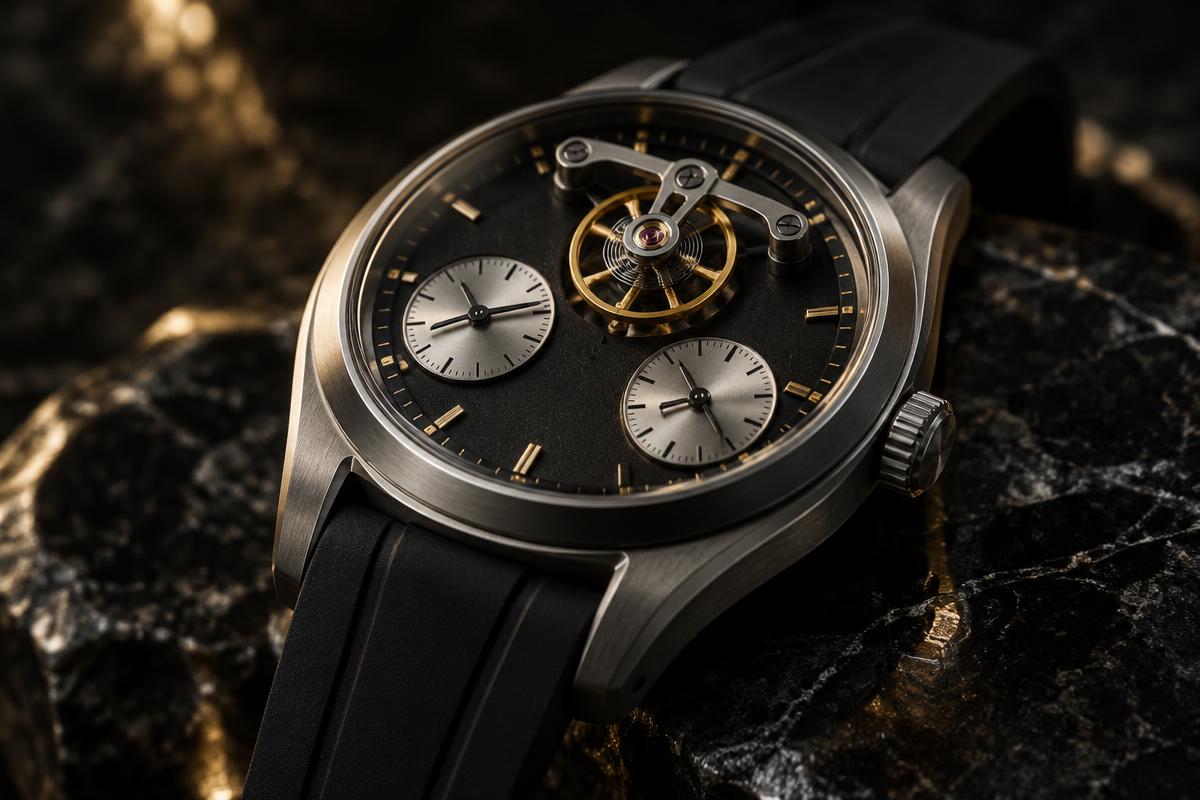
Featured image: an original AI-generated, brand-neutral watchmaking still life; it does not depict the MB&F Legacy Machine No. 1 EVO.