Piaget's Andy Warhol 'Camouflage' Limited Edition: Pop Art in Stone and Gold
Some collaborations are licensing exercises; others are conversations between two houses of ideas. Piaget's second release with The Andy Warhol Foundation for the Visual Arts, announced around November 5, 2026, is firmly the latter. The new Andy Warhol "Camouflage" Limited Edition takes its cue from Warhol's 1986 Camouflage self-portraits — among the last great series of his career — and renders that unmistakable pattern not in print, but in ornamental stone and gold. As reported by Watchonista, Hodinkee and Fratello, the edition is limited to 86 pieces, a deliberate tribute to the year of the self-portraits that inspired it.
The partnership itself has roots worth remembering. Warhol owned Piaget watches during his lifetime, and the maison's Andy Warhol collection was formalized around 2024, leading to last year's "Collage" edition. The Camouflage piece, reference G0A51242 per Hodinkee and Fratello, deepens that dialogue — and it does so through the métiers d'art in which Piaget has few peers.
A dial built like a mosaic
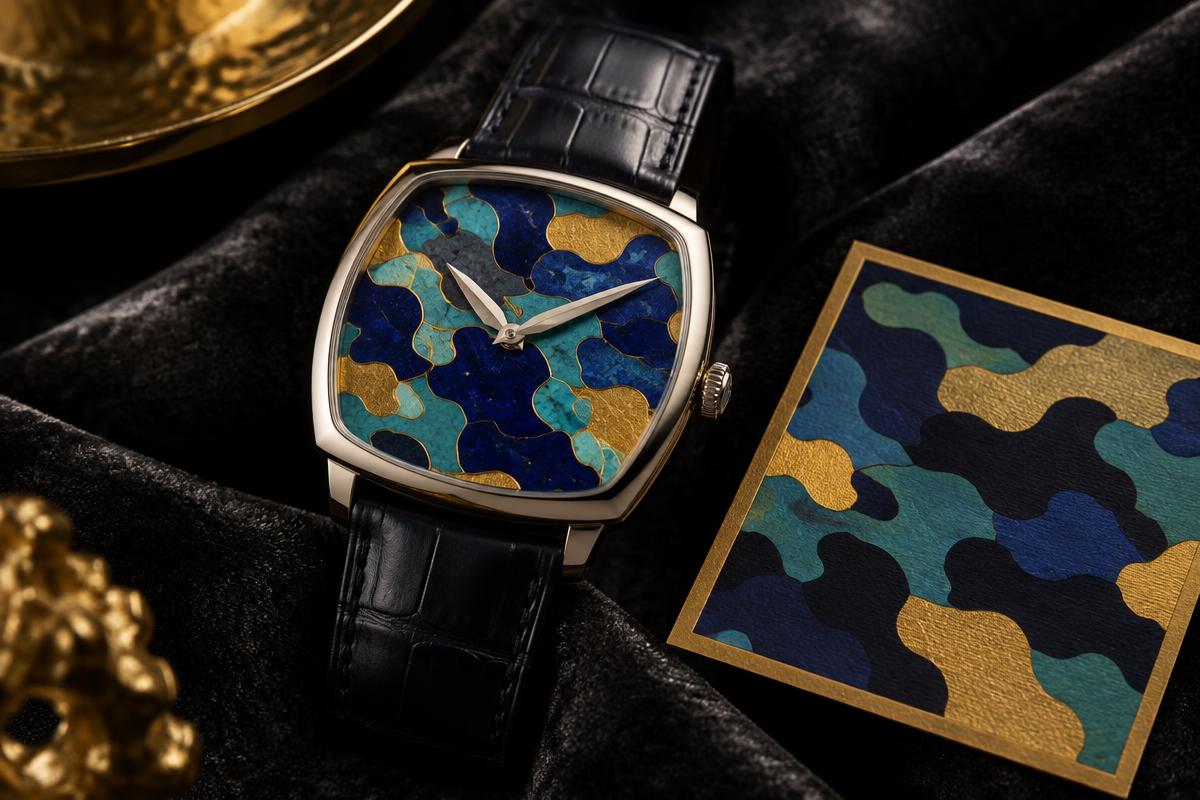
The dial is the story. According to Watchonista, Hodinkee and Fratello, it is a marquetry of 27 individual pieces in sodalite, turquoise, satin-finished yellow gold and polished rose gold, each fragment cut and set to recreate the interlocking shapes of Warhol's camouflage. The effect is closer to intarsia or hardstone inlay than to conventional dial-making: deep blues and blue-greens of the stones play against the two gold tones, and the whole composition sits beneath simple dauphine hands with the Piaget name at 12 o'clock. It is a dial that rewards a loupe — and one that no two examples will render identically, given the natural variation of stone.
Stone dials have a long association with Piaget's most adventurous decades, and their return here feels less like nostalgia than continuity. For collectors who follow how the grandes maisons handle artisanal dials, our Cartier and Vacheron Constantin selections offer useful points of comparison in how craft-led design holds its appeal over time.
The case and the calibre
The watch is housed in a 45 mm cushion case in 18K white gold with a rhodium finish, measuring approximately 8.08 mm thick with a lug-to-lug of around 43 mm (Watchonista / Hodinkee / Fratello). Those proportions matter: a 45 mm cushion wears more compactly than the number suggests, and the slim profile keeps it firmly in dress-watch territory despite the dial's exuberance.
Inside beats Piaget's in-house automatic calibre 501P1 — a movement of approximately 3.63 mm in height, running at 4 Hz (28,800 vibrations per hour) with a power reserve of roughly 40 hours and 23 jewels, per Hodinkee, Fratello and Watchonista. Thin automatics are a Piaget signature, and the 501P1's slender architecture is what allows the case to stay under nine millimetres. Water resistance is 3 ATM (30 metres) — appropriate for a piece that belongs at a gallery opening rather than in the sea — and it is delivered on a blue alligator strap with an 18K white gold pin buckle (Watchonista / Fratello).
The caseback carries the collaboration's signatures: per Fratello, a laser engraving combines the Piaget logo, Andy Warhol's signature and the limited-edition number. It is a discreet touch — the kind of detail that will matter to future owners authenticating one of the 86.
Price and positioning
On pricing, the reports diverge in an instructive way: Watchonista reports a price of CHF 74,000, while Piaget and Hodinkee list the price as upon request. We will not speculate beyond that. What can be said is that an 86-piece edition built on stone marquetry, in precious metal, from a maison with Piaget's métiers d'art bench, occupies a different collecting category from a standard production reference — and editions of this kind tend to be allocated rather than simply sold.
What it means for collectors
Three observations for those watching from the collecting side. First, artist collaborations with genuine material craft — marquetry, enamel, gem-setting — have consistently aged better than logo exercises, because the object stands on its own merits even when the cultural moment passes. Second, the 86-piece run is small enough that condition and completeness will dominate any future secondary-market conversation: box, papers and an unmarked case will separate the exceptional from the merely available. Third, the Warhol connection is structural, not decorative — the Foundation partnership, the renamed collection, and Warhol's own history of wearing Piaget give the piece a provenance narrative that begins at launch rather than accruing over decades.
That last point carries a lesson for anyone buying Pre-Loved (Certified): the pieces that hold their footing are those where story, craft and documentation align. When you shop our watches collection, every piece is inspected, authenticated and described to that standard — original dials, honest condition, complete records wherever they exist. Whether your taste runs to a marquetry dial or to the enduring restraint of a Rolex, the discipline of buying well is the same. Eighty-six collectors will own the Camouflage; the rest of us can admire the idea — and buy with the same care Piaget applied to making it. Featured image: an original AI-generated, brand-neutral depiction of a marquetry-dial cushion watch; it does not depict the actual Piaget product.
Sources: Piaget; Watchonista; Hodinkee; Fratello; T3.