Cartier LOVE Unlimited: The New Diamond-Set Pieces of October 2026
Few pieces of jewelry carry the cultural weight of the Cartier LOVE bracelet. Created in New York in 1969, the design has been defined for more than half a century by its visible screw motif — a deliberate, industrial detail that turned a rigid gold oval into one of the most recognizable objects in fine jewelry (Cartier.com). This October, that icon enters a new phase: the LOVE Unlimited collection, introduced by Cartier in 2025 as flexible, connectable versions of its most famous designs (Mojeh, Oct 7 2026), has just gained its most significant additions yet.
What is new in October 2026
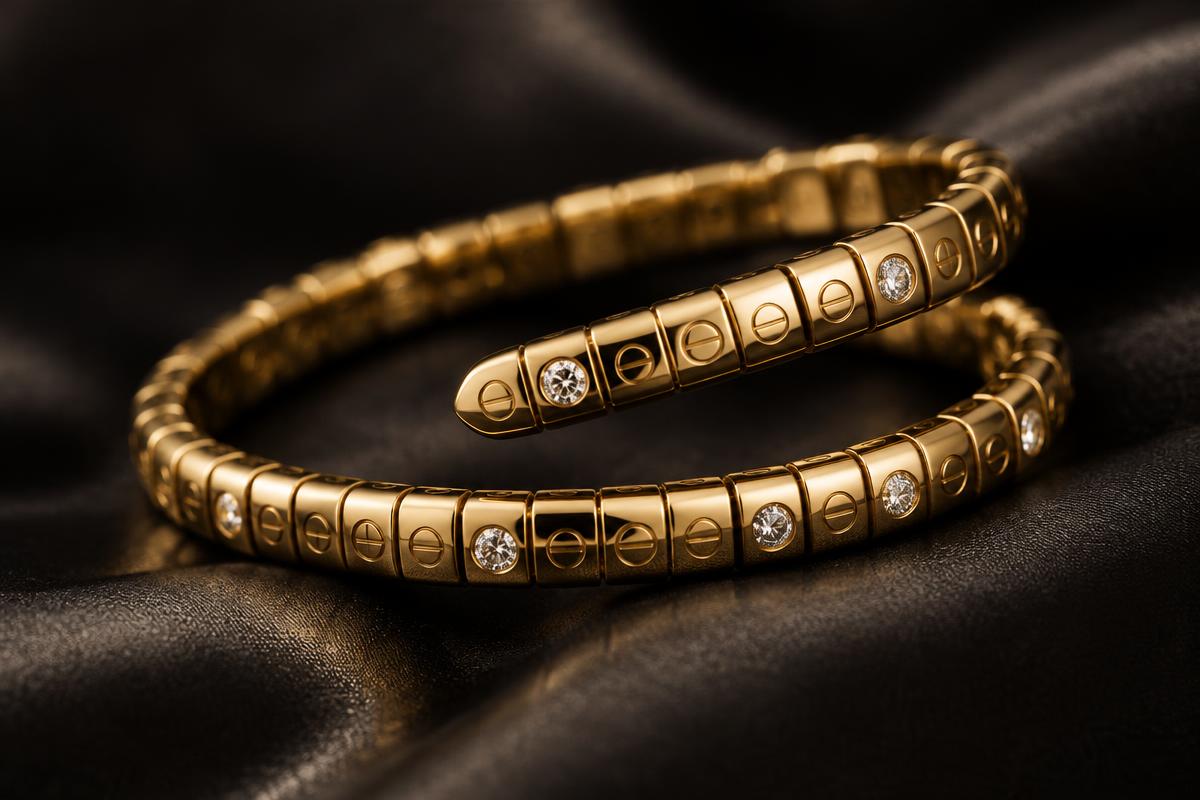
The October 2026 update brings diamonds to the collection for the first time, alongside a new all-gold flexible necklace (Cartier press release via CIJ International; Emirates Woman, Oct 2 2026). The new bracelets and rings set round diamonds in place of the LOVE screws — a quiet but telling evolution of the design language.
Details matter here. The diamond bracelets carry a total of 0.80 carats of round diamonds, and the settings that hold them are crafted in white gold even on the yellow and rose gold versions, a choice Cartier makes to enhance the brilliance of the stones (CIJ International; Emirates Woman). On Cartier.com, the flexible diamond bracelet in the rose gold version (reference CRB6094214) is listed with 7 brilliant-cut diamonds totaling 0.80 ct for size 17, 7 mm wide, at $21,600 — with carat weight and stone count varying by size. It is offered in yellow, white and rose gold, each with white-gold settings where applicable, and with two closure options: the original closure and a single-screw closure.
The rings follow the same logic. Matching LOVE Unlimited rings set with 6 diamonds come in yellow/white, white and rose/white gold; Cartier.com lists the rose/white gold 6-diamond ring at $8,250, while the plain yellow gold LOVE Unlimited ring is listed at $2,670.
Engineering an icon
The most underappreciated fact in the announcement is technical: each LOVE Unlimited bracelet and necklace is assembled from 200 miniaturised components, each hand-polished (Cartier press release via CIJ; Mojeh). The original LOVE bracelet was a rigid oval that required a screwdriver to close. LOVE Unlimited keeps the screw motif but rebuilds the object as a flexible, wearable structure — hundreds of tiny parts moving together so the bracelet behaves like fabric and the necklace like ribbon.
The system is also deliberately connectable. The diamond bracelet can be attached to another bracelet thanks to an invisible Cartier-patented clasp, so it can be worn as a pair or layered with the all-gold version (CIJ International; Emirates Woman). This is a collection designed for stacking — and for growing over time.
The necklace
The new flexible necklace is the collection's statement piece. It drapes like a golden ribbon, with gadrooned links interspersed with LOVE screws, and is offered in rose gold, yellow gold or rhodium-plated white gold (CIJ International; Mojeh). Where the bracelet is an icon rendered flexible, the necklace reads as a broader idea: the LOVE screw language translated into something softer and more fluid, closer to an everyday fine chain than to a cuff.
What this means for collectors
A collection like this changes how the existing LOVE universe is read. When a maison invests in flexibility, connectable clasps and diamond-set screws, it is signaling that the design language — not any single rigid object — is the asset. For collectors, three practical points follow.
First, on stacking and metals. The diamond-set pieces intentionally mix metals within a single bracelet, using white-gold settings on yellow and rose gold bodies to lift the stones. That is a useful precedent: mixing gold tones across a stack is no longer a compromise, it is how the collection itself is designed. If you already wear a classic yellow gold LOVE bracelet, the all-gold flexible version layers with it naturally, and the two closure options let you choose how the pieces meet on the wrist.
Second, on sizing and wear. Flexible construction changes the fit compared with the rigid original — a flexible bracelet drapes and moves, so the size that suits a classic LOVE bracelet may not translate one-to-one. Trying pieces on, or measuring carefully against an existing bracelet you love, remains the surest way to size any of these.
Third, on the secondary market. The original LOVE bracelet has been produced continuously since 1969, which means there is a deep and well-established market for earlier examples. That depth is exactly why Pre-Loved (Certified) bracelets deserve a collector's attention alongside the new releases: a certified piece has been authenticated and graded before it reaches you, so what you are weighing is condition and provenance rather than uncertainty. Keep the box, the screwdriver and the papers when you buy — for a design built around a tiny screwdriver, those small pieces of the original presentation carry real meaning on resale, and complete sets are always the more confident purchase.
The arrival of diamonds on the LOVE screw also puts earlier, screw-motif-only pieces into clearer perspective. They are now the historical core of the design, and the history of Cartier's iconic bracelets explains why that motif has stayed legible for five decades: it is simple, structural and impossible to imitate casually.
The collector's bottom line
October 2026's additions — diamond-set flexible bracelets and rings, and the all-gold flexible necklace — make the LOVE collection more wearable and more layered than it has ever been. For buyers deciding between the new diamond-set pieces and the classics, the sensible frame is not either-or. The new pieces define where the collection is heading; the classics, especially authenticated Pre-Loved (Certified) pieces, define what it has been. A considered collection usually holds a little of both — and buys each one with its papers in order.
Note: featured image is AI-generated and brand-neutral.