Geneva Jewel Auctions, November 2026: The Bulgari Pink, the Devonshire Tiara and the Romanov Sapphire
Geneva closes its autumn auction season this week with two of the year's most consequential jewelry sales, and the week's story is written in provenance rather than in carats alone. Christie's sells its Magnificent Jewels on the evening of 10 November, Sotheby's follows with Royal and Noble Jewels on 11 November, and Phillips has already concluded The Geneva Jewels Auction: VII on 9 November. Results for the Christie's and Sotheby's lots were not known at the time of writing, so what follows is a preview of what the week asks collectors to look at.
The Bulgari Pink: a stone that has never been offered at auction
Christie's Magnificent Jewels sale takes place at 4pm CET on 10 November 2026 at the Four Seasons Hotel des Bergues, covering lots 501 to 613, with public viewing from 5 to 10 November, as reported by Limited Editions Europe from the Christie's sale page. The headliner is the 'Bulgari Pink': a 24-carat fancy intense pink emerald-cut diamond set in a platinum Bulgari ring from the 1950s, carried at an estimate of CHF 10-15 million — roughly $12-18 million — excluding buyer's premium, per JCK and Rapaport.
What makes the stone remarkable is less its color than its biography. It belongs to a European noble family, and according to the family the owner's great-grandfather acquired the uncut stone in India in the 1950s and took it to Bulgari, JCK reports. Christie's says the diamond has never been offered at auction and has been held in private hands for more than 70 years. It is a Type IIa diamond, a category Christie's says accounts for under 2% of gem-quality diamonds, JCK notes.
Il Sole 24 Ore reports the stone was sourced from the Golconda mines, and quotes Christie's specialist Louisa Haniel-Jackson: "Diamonds mined at Golconda have characteristics that set them apart from all others, being particularly pure and transparent." That line explains the week's mood: collectors are buying a place of origin, a house that set the stone and a documented line of ownership, none of which a laboratory report can manufacture.
A connoisseur's collection, built around Mystery Set sapphires and rubies
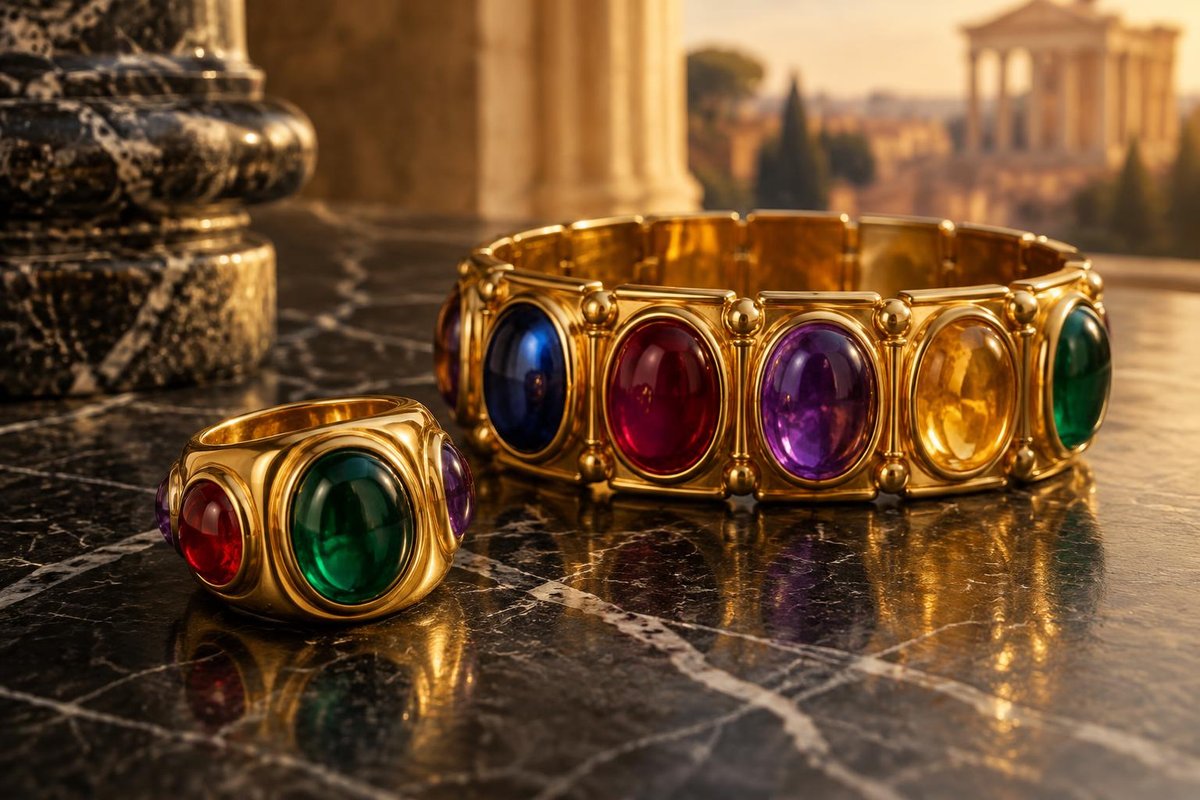
Christie's Geneva also offers 'Exceptional Jewels & Objects of Elegance: A Connoisseur's Collection', a single-owner collection with creations by Van Cleef & Arpels, Cartier, Graff and David Morris, centred on a group of Van Cleef & Arpels Mystery Set jewels set with sapphires and rubies, JCK reports. The Mystery Set — stones slid into channels of gold with no visible prongs — remains one of the few techniques that a viewer can authenticate at a glance, which is precisely why it has held its position at the top of the signed-jewel market.
Il Sole 24 Ore notes the collection's highlight is a 14.63-carat orange-pink diamond ring by David Morris, estimated at $1.6-2.6 million, alongside Cartier Art Deco enamelled cases, 18th- and 19th-century gold boxes, and a 1930s Cartier Saint Christopher dashboard plaque starting at CHF 2,500 — a reminder that a house signature on an object made for a car dashboard carries only a fraction of what the same signature carries on a ring.
Sotheby's: coronation jewels and a sapphire with an imperial past
Sotheby's Royal and Noble Jewels sells at 5pm CET on 11 November 2026, with viewing at the Mandarin Oriental Geneva from 6 to 10 November, per Limited Editions Europe. The sale is built around pieces with verifiable court histories, and the most quoted of them is the Devonshire Cartier opal tiara: made around 1937 for Mary Cavendish, Duchess of Devonshire, worn at Queen Elizabeth II's 1953 coronation and shown in the V&A's 2025 Cartier exhibition. It is an Art Deco composition of black opal and diamond, and it converts into a necklace and brooches. Its estimate is CHF 780,000-1.1 million, per Haute Living.
Beside it sits the 'Romanov Sapphire', a 197.80-carat Ceylon sapphire that has not been heat-treated, once set by Fabergé for Empress Dowager Maria Feodorovna and set by Cartier into a bracelet in 2015, estimated at CHF 850,000-1.7 million, Il Sole 24 Ore reports.
Haute Living, via Limited Editions Europe, lists further highlights: an 1862 Mellerio dits Meller diamond tiara made for the London International Exhibition at CHF 300,000-500,000; an 1880s emerald and diamond bangle from Amélie of Orléans, last Queen of Portugal, set with a 27.38-carat Colombian cabochon emerald at CHF 70,000-100,000; a toi et moi ring pairing a 7.83-carat Kashmir sapphire with a 6.77-carat Colombian emerald, linked by Sotheby's to Catherine Walston, at CHF 350,000-500,000; and a Bucherer necklace with a 43.07-carat Ceylon sapphire at CHF 320,000-480,000.
Phillips has already spoken: a lesson in what estimates miss
Phillips concluded The Geneva Jewels Auction: VII on 9 November 2026, according to its results page. Il Sole 24 Ore noted the sale included a pearl and diamond necklace that had belonged to Queen Mary (Mary of Teck), estimated at CHF 125,000-180,000, and a gem-set gold cross pendant that had belonged to Rudolf Nureyev.
One verified result from the sale makes the week's argument better than any forecast could. Lot 342 — a Marcus & Co. enamel, hardstone and diamond desk timepiece from the 1920s, estimated at CHF 7,000-14,000 — sold for CHF 67,080. A maker less famous than the houses above, an unusual object category, and a low estimate: the hammer price landed at roughly five times the high estimate. Estimates are guardrails, not predictions, and a well-documented piece in an unexpected format can clear them entirely.
What this week asks of buyers
The through-line across all three sales is not pink diamonds or coronation tiaras specifically. It is that the top of the market is being paid for three things: provenance that can be traced, a signature that identifies who made the piece, and stones whose origin and treatment are documented rather than assumed. Golconda origin, no heat treatment, a Fabergé setting, a 1953 coronation, a single-owner collection — these are all forms of the same evidence.
The same principles apply when you are buying signed Pre-Loved (Certified) jewelry. Ask who made it and look for the signature and number; ask whether the stone's origin and treatment are documented; ask whether the paperwork supports the story. Then inspect the piece — clasps, hinges, settings, signs of repair — because a documented history does not excuse poor condition. Our Authenticity Promise sets out how we approach that inspection.
For further reading, our preview of Geneva watch auction week covers the watches side of the same season, and signed jewels at October 2026 auctions looks at how the signed-jewel market behaved in the month before this one.
Geneva this week is a reminder that the most valuable thing a jewel can carry is the truth about itself. Buy for design and the pleasure of wearing it, with the documentation to prove it.
Sources: Christie's sale page as reported by Limited Editions Europe; JCK; Rapaport; Il Sole 24 Ore; Haute Living via Limited Editions Europe; Phillips results page.
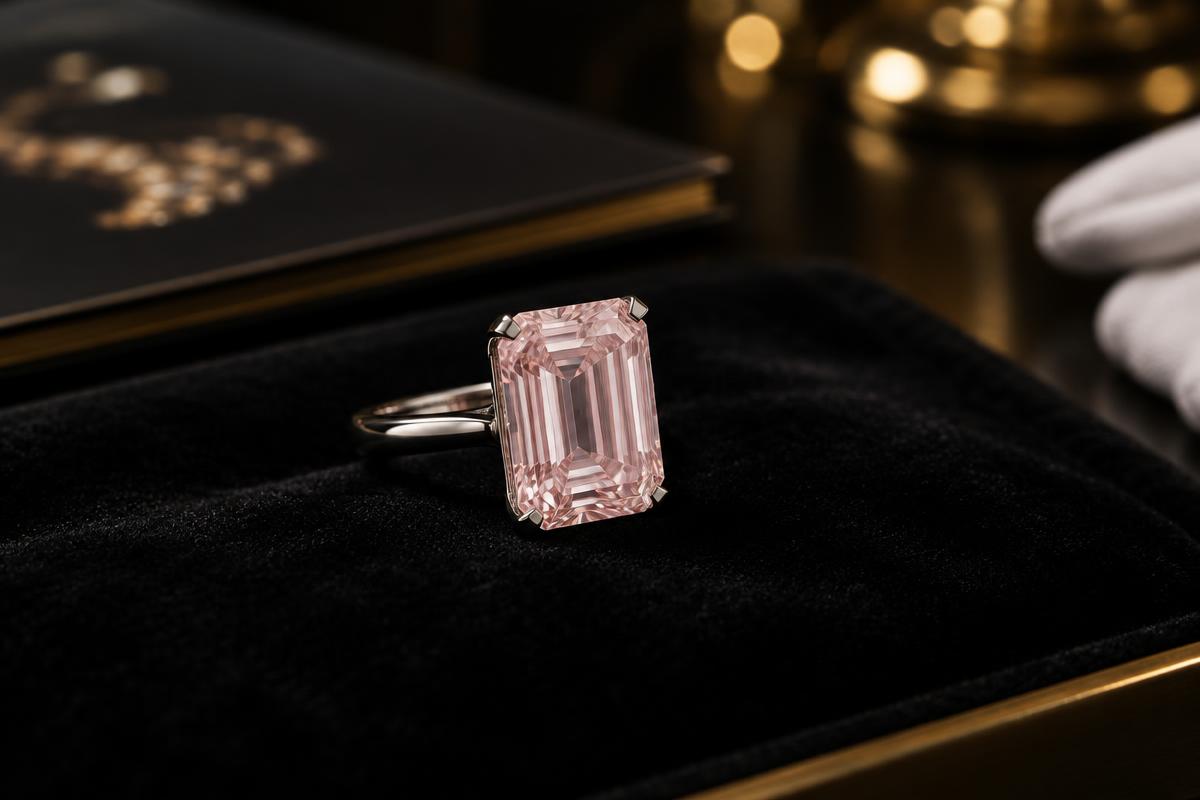
Featured image: an original AI-generated, brand-neutral still life of an emerald-cut pink diamond ring on black velvet; it does not depict the Bulgari Pink or any other lot mentioned.